
Demand Assessment with HCP and Patient Samples: A 2026 Perspective
2026 Preface
Demand assessment has always lived at the intersection of realism and scalability. When I first wrote on this topic in 2007 the industry was wrestling with how to incorporate patient-level nuance without collapsing the ability to forecast at the market level. That tension hasn’t gone away — if anything, it has intensified as clinical complexity, data fragmentation, and therapeutic personalization have increased.
What follows is a current articulation of a principle that still guides my work today: methodological realism is only valuable when it preserves — rather than obscures — our ability to make reliable market-level predictions.
Introduction
In pharmaceutical market research, demand assessment traditionally relies on practice-level allocation exercises. These exercises ask physicians to estimate how a new treatment would shift prescribing patterns across their patient base. While analytically tractable, this method has been criticized for oversimplifying the complexity of real-world prescribing decisions.
The Tradeoff: Realism vs. Aggregation
To address realism, some researchers have introduced patient-level vignettes — detailed profiles that simulate real clinical scenarios. Physicians are asked whether they would prescribe a new treatment to a specific patient, allowing for demand assessment in a discrete choice modeling framework. However, this approach complicates aggregation. Without reliable data on the joint incidence of patient characteristics, market-level extrapolation becomes speculative. Even if marginal distributions (e.g., 50% male, 40% obese) are known, the internal cell estimates (e.g., obese males) require statistical estimation techniques like Iterative Proportional Fitting (IPF), introducing uncertainty.
An Integrative Approach
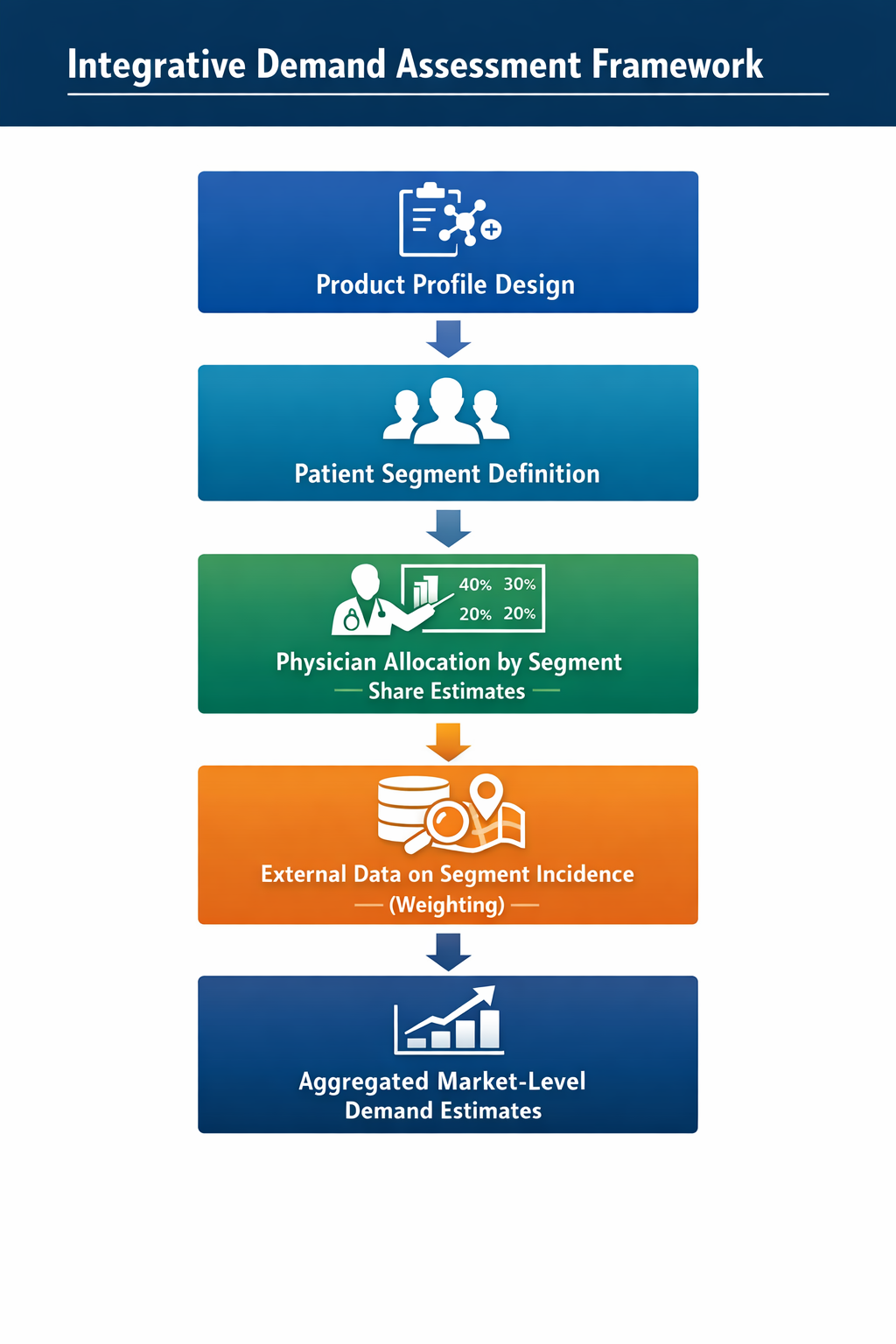
A more robust solution blends the strengths of both methods. By segmenting patients into clinically meaningful groups (e.g., mild/moderate/severe or treatment-naïve vs. experienced), researchers can preserve aggregation logic while capturing variation in physician behavior. Physicians allocate share within each segment based on exposure to experimentally designed product profiles. These segment-level shares are then weighted using external epidemiological data to produce market-level estimates.
Conclusion
Both practice-level and patient-level approaches offer valuable insights, but each has limitations. The integrative approach provides a pragmatic path forward — one that respects the complexity of clinical decision-making while maintaining the rigor required for market forecasting. By combining structured product profiles, meaningful patient segmentation, and reliable external data, we can generate demand estimates that are both realistic and actionable.